
The Benefits of Learner Autonomy in Language Learning
By: Curtis Kelly
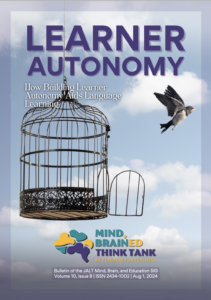
Learner autonomy, a popular term in language education, is a relatively recent expression. It was coined in 1981 by Henri Holec; in his words it means the “learner’s ability to take charge of his or her own learning” (LearnUpon Blog). According to Wikipedia, this idea led to self-access learning centers all over the world, including the SALC at Kanda University of International Studies in Japan.
Wikipedia also offers some definitions of learner autonomy from the literature, including:
- “In order to help learners to assume greater control over their own learning it is important to help them to become aware of and identify the strategies that they already use or could potentially use.” (Holmes & Ramos, 1991, cited in James & Garrett, 1991, 198).
- “Autonomy is a situation in which the learner is totally responsible for all the decisions concerned with his [or her] learning and the implementation of those decisions.” (Dickinson, 1994).
Autonomy offers learners many benefits. It moves the focus from teaching to learning, it allows them to personalize their learning and de-institutionalize it, and it instills responsibility, in itself is an educational goal. And of course, it leads to lifelong learning.
Hayo Reinders (Innovation in Teaching, 2010) portrays gaining autonomy from the learners perspective. He compares it to a journey, and like all journeys, it has turns and twists, pleasures and discomforts, and always, unexpected discoveries.
- Learner Autonomy is, first and foremost, a mindset. A way of thinking about learning as a journey where you decide where to go and how to travel.
- You, and you alone, can make the decision to start the journey.
- Becoming autonomous is a process of discovery.
- Autonomy, then, is an intimately personal affair. It is about what you want to achieve, and what you enjoy.
Locus of control
Another important benefit can be seen from a brain science perspective. Autonomy moves the “locus of control” from the outside to the inside. Locus of control, a concept developed in the sixties in psychology, represents the way people see control of their lives (source). People with an external locus of control feel that outside forces control their lives, that they are being forced to live a certain way and do certain things. A person with an internal locus of control feels they are in charge of their own lives, that they hold the keys to what happens.

This table shows the characteristics of these two orientations (source):
InternalLocus of Control | ExternalLocus of Control |
|
|
Due to their age and situation, it is hard for some students to have an internal locus of control. Control, itself, is external in early education, but tends to move inwards across secondary, tertiary, and adult education. Thus, the locus of control (perception of that control) moves with it, across the continuum from external to internal. Of course, the speed and direction of movement is heavily influenced by the learner’s traits and the kind of teaching they are subjected too. Progressive open schools for children offer extreme internal control, while military boot camps for adults keep it wholly external. Nonetheless, adult learners have a strong preference for autonomy and internal locus of control. As Knowles put it, they are “non-directed learners” (source). One of the paradoxes, however, is that adults just entering adult education, where autonomy is offered, are often trapped in the external locus of control mindset of their youth, expecting to be told what to do and how to do it. Adult educators must relieve them of this notion.
Being on the internal locus of control side of the continuum has huge advantages in life and learning. People with internal locus of control are more likely to be emotionally stable, more likely to enjoy positive effects, and more likely to experience higher self-esteem. They are also more motivated to engage in learning. In fact, internal locus of control leads to the growth mindset, the most beneficial for learners, while external locus of control leads to the fixed mindset. See our Think Tank on mindsets.
Helping learners become autonomous shifts their locus of control from external to internal, resulting in happier students who are more willing to learn. As Harumi Kimura tells us in her article in this issue, the opposite, learned helplessness, is the destroyer of internal locus of control, and a particular threat to young language learners. And the symptoms, as you can see below, are barriers to learning. As Harumi tells us, we overcome the dire effects of this malady by using materials that promote autonomy.

In his article, Jamie Emerson points out another aspect of learner autonomy grounded in brain science: self-regulation as a product of interoception.
Learner autonomy as our goal
And so, I think we can say that autonomy is the ultimate goal of language education, not just because it leads to happier, more engaged learners, but also because it leads to lifelong learning. Autonomy is the self-actualization that allows learners to continue on to higher levels of language mastery than can be achieved in the limited number of classes we provide. Wonderful.
But is our view of autonomy distorted?
I suspect the way we see autonomy might be distorted. If autonomy means studying “on one’s own” as Holec stated, does that mean studying alone, in solitude? That question came up when we editors were discussing this Think Tank.
Stephen (in Japan) wrote:
The more I think about Autonomy and what we have understood so far about Brain Science, the fewer connections I see.
We have been saying for over three years that learning is social. If it’s social (and I think it is), why would we strive to help our students become autonomous? Surely, it has more to do with the fact that many of us come from societies where many people consider autonomy to be a desirable goal than it does with our (limited) understanding of how learning works.
And Heather (in Germany) wrote:
I, too, have been thinking about what aspects of education that I’m familiar with are tied to western, Eurocentric ways of viewing the world. For example, when I think of a scholar, what immediately comes to my mind is a man sitting in his study surrounded by books and papers who is thinking deeply and making discoveries in solitary fashion. This scholar has people around him (servants, maybe his wife) who support his intellectual endeavors by cleaning his home and preparing food for him. Very Middle-ages, right? This “scholar” has to be an autonomous learner. Maybe he belongs to some intellectual society and writes letters to other scholars, but he’s still gotta be a very self-directed learner. How much of this view of scholarship is built on competition and resource scarcity? To what extent are teachers today promoting/replicating this view of a scholar and scholarship, perhaps unconsciously? And is this only in some parts of the world? I’m familiar with education in the US and Germany but have no idea about the situation in other countries.
Yes, I agree that learning is social. Helping students build community in the classroom can foster learning. So, is the notion of “autonomous learning” outdated or Eurocentric?

Stephen and Heather then, have challenged the notion that autonomous learning fits the way many of us learn best, through a more social frame. And because of their insightful comments, I suddenly had a realization. Being autonomous, while highly personal, does not have to mean “alone,” and I wonder to what degree it should or should not be alone in language study.
Language is a skill of interaction, an exchange of information with others, so while solo study may aid the gaining of that skill, it can never be more than just a sideline to the process. Essentially, since language must involve others, so too must its learning.
Stephen later wrote that autonomy could be seen in different ways, as “solitary” or as “undirected” and that he did not see much in the literature that supported the solitary side. He also noted that what he saw in non-WEIRD1 educational traditions were far more social than ours. So, for him, then, autonomy means helping learners learn with “freedom from directives” rather than learning in solitude.
In short, while autonomous learning can be solitary, it does not have to be solitary, as Ribeiro, Sudhershan, and Schemien write about in their article. It can also occur with others, as long as the learner has control of their part of the interaction and how they learn from it. Autonomy means letting them use their own language to communicate something, without being directed every step of the way by the teacher.
And so here we are again, back in one of my favorites topics: TBLT (Task-Based Language Teaching)2 TBLT relies on learner’s being autonomous. TBLT, according to Rod Ellis, is where students engage in a task to achieve some non-linguistic outcome, using their own linguistic resources to do so. A task usually involves some kind of gap, such as an information gap. The task might be completed alone or in pairs, but again, the crux is that it is autonomous: The learners, not we teachers, control the language they use and the means of solving the task. I like to think of TBLT as “L2 internship.”
1 WEIRD, an acronym for “Western, educated, industrialized, rich and democratic.”
2 See one of our favorite Thinks Tanks, on that very topic, here.

In conclusion
Even if it is difficult to achieve, the benefits of learner autonomy should be obvious by now, and we should include it as one of our educational goals. Another goal we might take on is making sure our colleagues understand that autonomy does not mean solitude in language study. Instead, it means freedom from direction. Not being able to direct what is studied, when, and how is a hard thing for any teacher to give up, since all our training tells us to do the opposite. But to build autonomy, we must know when to intervene and when to step back, and then still intervene less than we think we should. Maybe building learner autonomy is harder for us than for them. I, for one, must add one more tool to my teacher’s toolbox, biting my tongue!
At the start of this article, I put five insights on learner autonomy from Hayo Reinders, but let me add one more here. He portrayed autonomy as similar to embarking on a journey by oneself, but also added:
- But just as good travelers listen to others and learn from their experiences, good learners are not islands. They rely on others to offer insights, and occasionally, show them the way.
Let us show the way and then step back.

Curtis Kelly feels a bit solitary in Portland, Oregon, right now, while his family is in Japan. He both embraces and despairs of the solitude.