Flying Towards Learner Autonomy Together
By: Heather Kretschmer
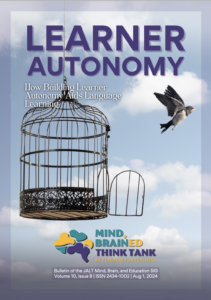
The cover of this month’s Think Tank features a photo of a bird escaping from a cage, which reminds me of a learner escaping a classroom. That photo made me stop and ask myself some hard questions: To what extent is my classroom like a cage? In what ways do I constrain learners? Can I loosen these constraints a bit and maybe even open the cage door? What happens when the cage door opens?

In our Main video, Devi Sahny gives us lots of examples of what happens when the cage door opens. Working as a tutor for an economics class, she helped her tutees take charge of their own learning in a variety of ways. For example, she met with a basketball player on the basketball court because that space helped him visualize concepts. She tutored a singer over the phone because that student liked to learn aurally. And she explained concepts in French to a student who preferred to learn in her native language. Key questions she asked students were: What do you want to learn? and How do you want to learn it? By asking these questions, she gave these students agency over the content, method, and pace of their learning, allowing them to gain more autonomy. But she notes that the teacher still has a role to play, and “autonomy should not be understood as a black or white term […], but rather you can have a degree of autonomy.”
This “degree of autonomy” indicates that autonomy is on a continuum. It means that guiding learners towards autonomy isn’t about simply opening the cage door and saying, “Goodbye! Fly free!” Instead, it means opening the cage door and accompanying learners on their journey of becoming more autonomous learners. I’d like to take this “flying towards autonomy together” metaphor a step further into the realm of music. If there were such a thing as a “learner autonomy soundtrack,” then I believe Ralph Vaughan Williams’ The Lark Ascending would be the first piece on that soundtrack.

The Lark Ascending is an orchestral piece in which the lark is depicted by the solo violin. In the piece, we hear the lark rising upwards to soar high above the world. At times, the lark flies alone, but more often, the lark swoops down to interact playfully with other birds and animals portrayed by the oboe, clarinet, flute, and French horn. For me, these musical interactions are like students coming together to help one another become more independent learners. In the piece, the solo violin is often accompanied by the strings, who in my imagination represent the teacher supporting the learners by scaffolding learning and encouraging learners to move away from relying on the teacher. Our More video gives language teachers a lot of advice and practical tips to do exactly this.
In the More video, Samantha Lewis presents key information about learner autonomy. Quoting Jack C. Richards, she states that “learner autonomy refers to the principle that learners should take an increasing amount of responsibility for what they learn and how they learn it.” She emphasizes that language teachers aren’t just helping students learn a language, they’re also helping them learn life skills. Three relevant life skills are: learning to learn, critical thinking, and collaboration. She describes a wide range of classroom activities aimed at helping students develop these three life skills and become more autonomous learners. The activities include vocabulary tasks, KWL charts, self-assessment activities, peer teaching and peer feedback tasks, and think-pair-share activities.

At the end of The Lark Ascending, the solo violin plays alone, symbolizing for me the fully autonomous learner who has taken charge of what to learn and how to learn it. I invite you to listen to this beautiful piece–maybe while you read the rest of this issue! Our authors show us a multitude of ways to open the cage door and fly beside our students on their journey into the skies of autonomous learning.

Heather Kretschmer teaches English at the University of Göttingen in Germany.