
A Gift Basket of My All-Time Favorite Discussion Activities after Forty Years of Teaching
By: Curtis Kelly

My favorites. That’s a tough one. I guess I wrote the title before I really thought out what I would or would not include. After all, if I included all my favorites, we’d need two more Think Tanks. But here is a gift basket of goodies, with an extra focus on two particular types of discussion activities: values clarification and critical incident tasks. Both are used extensively in intercultural communication classes, although that is not really why I put them in this basket.
For me, a good discussion activity has these criteria:
- The task is easy enough language-wise that the students stay in the target language.
- The task is TBLT-ish in that language is just the conduit to get to some other goal and the learners use their own linguistic resources.
- The activity is fun, personalized, thought-producing, social, or introspective, so that students enjoy it.
So, let’s take the plastic off this gift basket and see what is on top, some of the lighter, easy-to-digest bits. Oh! I see my favorite snack, picture-based information gap mysteries! These can be used with students from late beginner to near-native speaker levels, since the challenge is in the content, not the language. That is a pretty wide range, but I have found that, in output tasks, learners tend to produce language at whatever their level of proficiency is, whether that be simple utterances or sophisticated monologues.
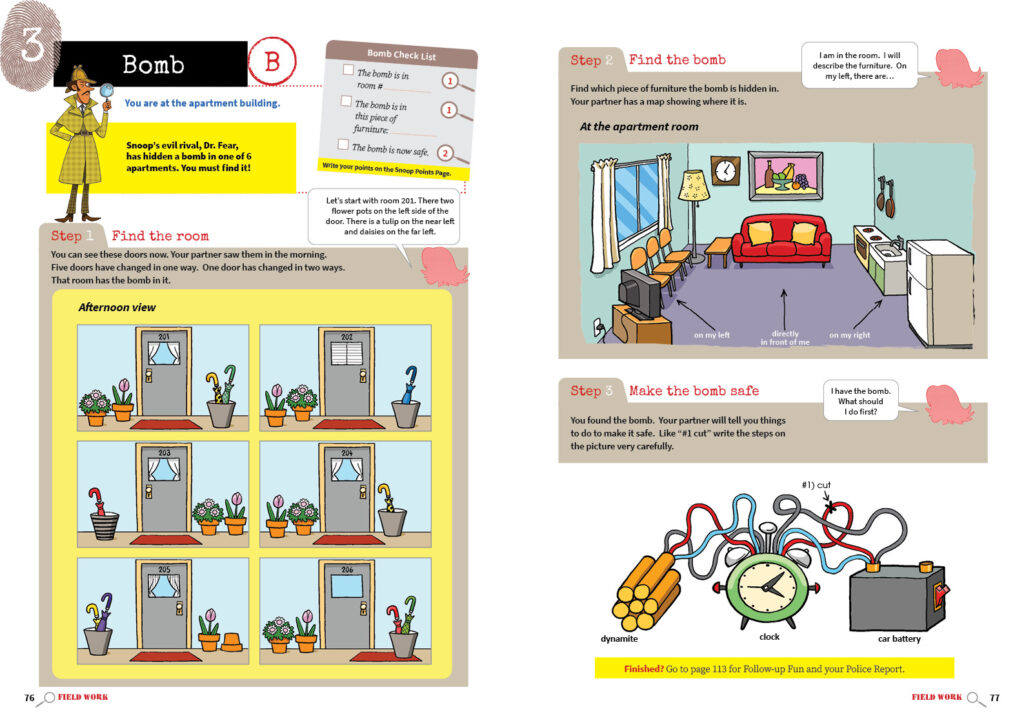
Information gap crimes to solve
I’ve made over twenty picture-based information gaps, covering everything from saving endangered species to tailing thieves. My latest effort is on crimes to solve, the Field Work pages in the Snoop Detective School (Abax, in press). There are three sample units with two crimes to solve here. The mysteries below are on the last few pages. Guaranteed fun!

Storytelling-based discussion games
Digging a little deeper into the basket, I can see some tasty storytelling discussion activities, based on old parlor games, and bound to get smiles. And next to those, I see some interview activities.
“Believe It or Not,” from Active Skills for Communication 1, is tons of fun. Students sit in groups of four and must all answer the same question, such as “Have you ever kissed anyone you shouldn’t have?” (or a more mundane one, as in the book version the above link leads to). The key is that they must answer with a story that is either completely true or completely false. The other members try to figure out if they are lying or not.

“Tall Tales,” from Active Skills for Communication 2, is like the Bluff the Listener segment in NPR’s Wait Wait…Don’t Tell Me! Three students tell stories on a topic, one of which is a lie. The rest of the students ask questions and discuss the stories, trying to identify who the hoaxer is.

Interview-based discussions
We usually don’t like it when students use their cell phones in class, but here is an exception, and a good one for beginners (again from Active Skills for Communication 1). In “Favorite Photos,” students pair up. One shows the other a photo they like and that student asks wh questions about it. Simple, but satisfyingly personal.

Here are some more interviews. I found that my first-year college business English students, new to the school and a bit isolated, were keenly interested in making friends. Pairing them up to interview each other and fill in interview sheets was just what they needed. And since they had to fill in an interview answer worksheet, I could generally keep them in the target language! This set of speaking activities has interviews for: who you are, music likes, net use, favorite shops, personal mottos, likes and dislikes, future goals, and phone use.

Okay, that’s enough of these little snacks; now let’s get down to the full meals: values clarification and cultural critical incident discussions.
Values clarification activities
Alligator River is an old-time moral dilemma story, which has been modified in many ways. Here is a version I spiced up for Japanese college students. After reading the story, students rate the characters from liked most to least and then discuss their reasons. This Alligator River folder has instructions, a PowerPoint file, and a rating sheet.
Editor’s Note:
While some teaching methods and materials are considered classics, it is essential to adapt them to align with evolving societal standards. Please be aware that the following story contains sensitive elements, such as sexual coercion, violence, and victim blaming. These themes can inadvertently reinforce harmful stereotypes or cause discomfort for students.
When using this material, we encourage you to:
- Provide a clear trigger warning in advance.
- Ensure students are comfortable engaging with the content.
- Offer alternative activities for those who may find it distressing.
Creating a safe, respectful learning environment should remain a top priority.


Romeo and Juliet were in love. But they were separated by a dangerous river full of alligators. Still, Juliet could go to Romeo over the one small bridge that crosses the river.
But one day there is a storm and the bridge is destroyed. Juliet has no way to go to Romeo, but Romeo tells Juliet, “You must come to me. I love you so much. I cannot live without you.”
So Juliet goes to Sinbad, a man who owns a boat, and asks him to take her. He says he would, but only if Juliet spends the night with him. Juliet refuses.
Then she goes to her father to ask for help. Maybe he could convince Sinbad to do it for money. But her father says he does not want to get involved. “It is your problem, so leave me alone.”
Then she goes to her best friend, Wanda, and asks for advice. Wanda says, “Why don’t you sleep with Sinbad? It is just one night.”
So, Juliet does, and while she is with Sinbad, Wanda, who also likes Romeo, goes and tells him what Juliet is doing. The next day, Sinbad takes her across the river in his boat.
But Romeo screams at Juliet, “How could you sleep with Sinbad? You are a terrible woman. I hate you. I never want to see you again!”
Juliet goes back and is heartbroken. She cries and cries. Then a boy she knows, Slug, comes up and asks what is wrong. She tells him everything.
The story makes Slug so angry that he goes over the river and kills Romeo with a knife. Juliet is happy to see Romeo punished and she laughs and laughs.
Cultural critical incidents
Cultural critical incidents are situations with some sort of cultural conflict. Students read about the conflict and then try to figure out what the cause of it was. Their goal is to come up with as many explanations as possible before being told the real answer (if there is one).
Here are three I made for my Japanese college students based on true stories, but another good collection is available here.
True story: A young American, new to Japan, was riding the train. He stood, giving up his seat, and a Japanese man rushed in and sat down. The American kicked the man’s leg and got off the train in a huff. What cultural difference do you think caused the problem?
Real answer: The American, from a traditional area, stood up to give his seat to a woman, as was the custom where he came from. He was furious that a man rushed in and took it. The Japanese man, like all train riders, was just looking for a seat opening up when people got to their stations, so he took it.
True Story: A group of Hispanics were visiting a university in the US. There was a welcome party that Ellen and Maria, both Americans, attended. Both tried hard to engage in conversations with the guests. After the party, Ellen heard that the visitors considered her a bit cold, while Maria was considered friendly. Ellen was confused. Both she and Maria had talked about the same kinds of things, so why was she perceived as cold?
Real answer: Ellen had an American sense of closeness and personal space, which is a greater distance than Hispanics use. Ellen’s standing a few inches farther away, and even moving back if the Hispanic got closer, made them feel she was cold. Maria, with Hispanic relatives, did not have the problem.
True Story: One of my college professors who taught courses about Asia used to go to Vietnam. Even though he was a clean person and showered daily, the Vietnamese said he smelled terrible and that it was off-putting, even for their water buffalo. Why?
Real answer: Being a meat and dairy eater, he emitted what used to be called a “butter stink,” which was noted of Westerners in many Asian countries. They could smell it. He could not.
So, that is the gift basket. I could fill up a couple more, but these are my favorites. I’d love it if you’d try one out, and if you do, mail me and let me know how it goes!

Curtis Kelly (EdD) is a retired professor with over forty years experience in Japanese universities. He loves writing textbooks and making activities that help his life mission: “to relieve the suffering of the classroom.”