Current Issue

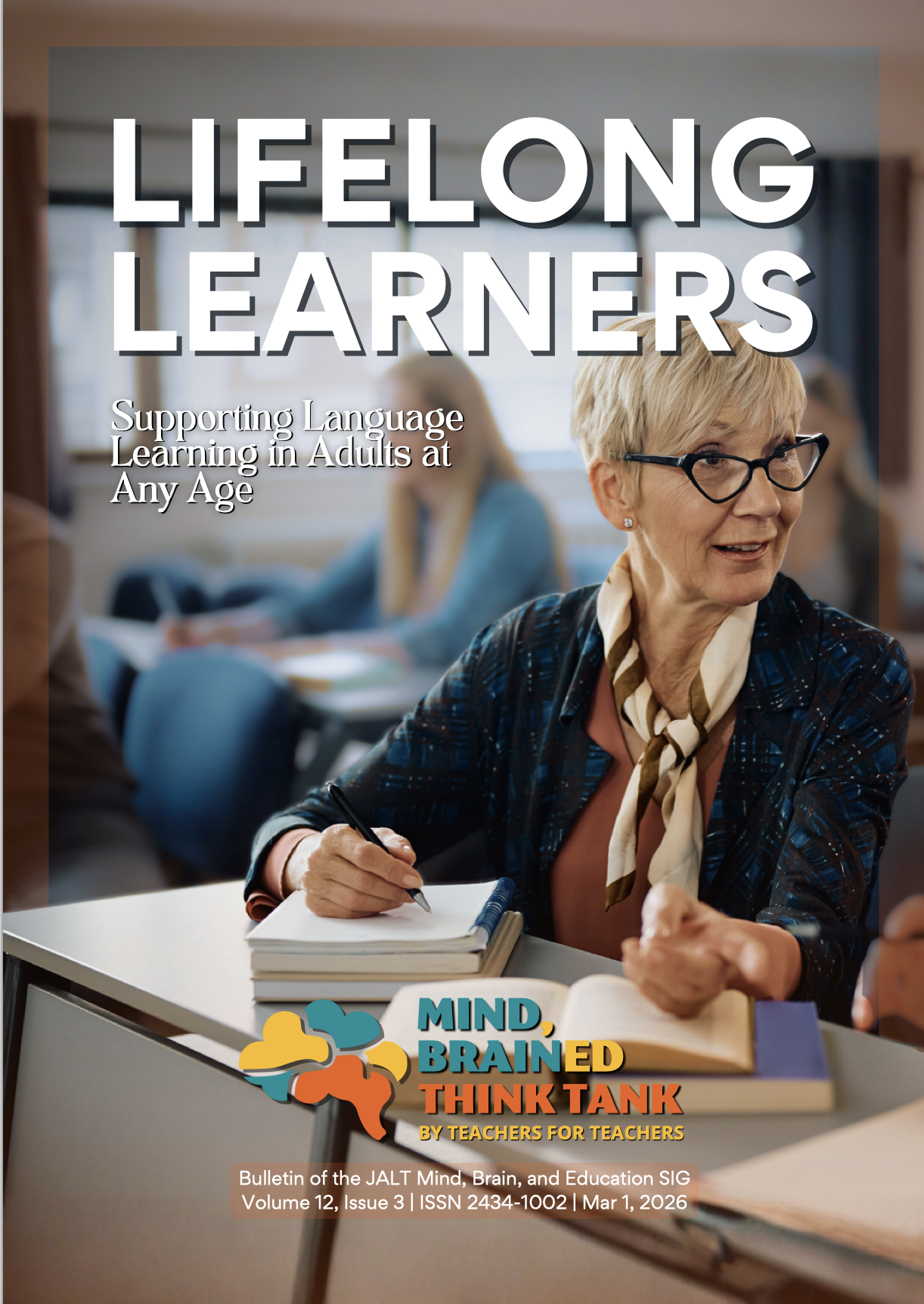
Supporting Language Learning in Adults at Any Age

March 2026

Learning isn’t just for the young–it’s for all of us, at any stage of our lives! This month, let’s look at how the best teaching techniques can sometimes differ depending on the age group of your students, with an extra focus on best teaching practices for older adult learners. Our brains grow and change throughout our lives, and these changes can impact how we learn new things at different life stages. 

“Anyone who stops learning is old, whether at twenty or eighty. Anyone who keeps learning stays young. The greatest thing in life is to keep your mind young.” — Henry Ford

APA Reference for this issue

(author). (2026). (article title, sentence case). MindBrainEd Think Tanks: Supporting Language Learning in Adults at Any Age, 12(3), (pages).

Watch before you read...

This month’s Think Tank explores the unique traits of adult learners, especially older adults, and the ways in which language teachers can design inclusive, effective learning experiences for mature learners. In the Main video, cognitive psychologist Alan Castel explains how the mind fills in gaps—leading to errors—and also how older adults excel at remembering what they find meaningful. In the More video, ELT professional Marina González offers practical guidance on teaching older learners. Then, Heather Kretschmer introduces the issue.

In the Think Tank, Peggy Thoma looks at how younger and older learners are similar, and how they’re different. Next, Curtis Kelly unpacks how shifting societal trends have influenced adult education and highlights what’s important for adult learners. Then, Amanda Gillis-Furutaka examines how aging affects our minds and bodies and reminds us that healthy habits are key to a rich and satisfying life. 

In our Plus, Mirela C. C. Ramacciotti traces early breakthroughs in psychology and neuroscience that shaped our current understanding of executive functions. 

Our Thoughts on Lifelong Learners

Strong Is the Force With Older Learners Heather Kretschmer

A long time ago, in a classroom far, far away . . . 

. . . I was teaching English to a group of beginners on the very first day of class. It was my first step towards fulfilling the student teaching requirement for my MA TESL degree. Although I had taught language classes before, I was still a fairly inexperienced teacher.

I arrived armed with activities that would help students learn and practice some basic greetings in English. My students, all adults ranging from their 30s to retirement age, were quite eager to learn. Walking into the classroom, I could sense their excitement and anticipation…

Think Tank Articles

Teaching Older Adults–Teaching Unplugged? Peggy Thoma

Teachers all around the globe spend a considerable portion of their careers reading, researching and trying out different teaching methods. After lots of trial and error, they manage to establish the methods that best complement their teaching style as well as their students’ needs. Until one day an older adult, over the age of 55-60, walks into their classroom. Some of these adults might want to learn English for work, which falls under business English, or for traveling, which falls under everyday communication, but now and then there’s a number of adults that come in and state “I just want to learn for myself.” The first few times I came across this statement, my amygdala was instantly triggered and my brain went into a fight or flight mode, and every time I conveniently chose flight. However, after the initial shock I reluctantly decided to take up some of these learners and this is what they have taught me.

Two Surprising Things about Adult Learners: A Boom and a Difference Curtis Kelly

Since Adult Education is my doctoral field, I’ve learned quite a bit about the topic, some of it surprising. Look below, for example. In earlier speeches I did on adult education, I showed this slide. I asked what it represented. I added it had to do with adults and Japanese universities. After some hints and prodding, someone would always guess correctly that it represented the number of adults (over 25) enrolled in Japanese universities…

Our Aging Brains and Bodies: The Good, the Bad, and the Inevitable (What to expect and what we can do about it) Amanda Gillis-Furutaka

We can change our hair color, strengthen our abs and pecs, undergo cataract and/or laser eye surgery, use an almost invisible hearing aid, study a new language, work on word and math puzzles, but what we cannot do is stop the march of time. And the passing years take a toll on our bodies and our brains. My goal is not to fill you with gloom about what is to come, but with a better understanding of the facts, and with the knowledge that good things also await you as you advance towards the later stages of life. We will look at changes in our brains that are good and not so good and then at the relationship between some inevitable changes in our bodies and our brains and ways in which we can mitigate and/or adapt to them. Finally, we will review the latest findings on the extent to which our genes’ influence alone determine our longevity.

Think Tank Plus

Great Ideas from the Brain Sciences: Executive Functions—The Origins Mirela C. C. Ramacciotti

Once upon a time, in a not very faraway land, I was giving a lecture on executive functions. When I mentioned that they were one of the most reliable predictors of academic success, a teacher raised her hand. Baffled by the term “executive,” she asked me: But how can I teach my class to deal with the demands of an executive? They are only children…

Call for Contributions: Ideas and Articles Think Tank Staff

Become a Think Tank star! Here are some of the future issue topics we are thinking about. Would you, or anyone you know, like to write about any of these? Or is there another topic you’d like to recommend? Do you have any suggestions for lead-in, or just plain interesting, videos? How about writing a book review? Or sending us a story about your experiences? Contact us.

Going Deeper

Your age shouldn’t put you off learning a new language – what the research says

Wondering if it’s too late to learn a new language? Karen Roehr-Brackin’s article makes the case for a confident yes. Read it here!

How to maximise the language learning of senior learners

In this British Council article, Kieran Donaghy celebrates the strengths of older learners and offers practical strategies for navigating the difficulties they may face. Check it out here.

Older adult learners

This Academia resource lists journal articles on older learners, extending beyond language learning, and includes sources in different languages.

The MindBrained Think Tanks+

is produced by the Japan Association for Language Teaching (JALT) Mind, Brain, and Education Special Interest Group (BRAIN SIG). Kyoto, Japan. (ISSN 2434-1002)

Editorial Staff

      Stephen M. Ryan               Curtis H. Kelly              Julia Daley     

 Afon (Mohammad) Khari     Heather Kretschmer     Nicky De Proost

Subscribe

Get issues delivered to your inbox at the start of each month!

Unsubscribe

Stop receiving issues in your inbox.

Reader's Survey

Take a short survey to help us learn more about our readers!